
Security Today 2014 (formerly GovSec West)
Security Today 2014 (formerly GovSec West)
Speaking Opportunities
1105 Media’s 2014 Call for Presentations for Security Today (formerly GovSec West), Safe & Secure Campus Symposium, and CPM Symposium (formerly CPM West) is now open.
The following events will be held jointly on November 17-19, 2014, at the Gaylord Texan Resort & Convention Center, Grapevine, TX (Dallas).
Security Today – an education forum for security professionals from both the public and private sectors focused on critical topics and important issues in the areas of security and resiliency
Safe & Secure Campus Symposium – an education forum for professionals from both the public and private sectors responsible for campus security and life safety of students, faculty, and visitors at K-12 and university/college campuses
CPM Symposium – an education forum for those responsible for preparing and planning for emergencies and disruptions of operations including response and recovery focused on critical issues in the areas of business continuity and resiliency planning and management
Participating as a speaker at these conferences provides you a chance to share your expertise, be recognized as an industry expert, and enhance your credentials.
We welcome submissions that match our education focus including, but not limited to:
– Counter and Anti-Terrorism and Border Protection
– Cybercrime, Cyberterrorism, and Cyber Security
– Critical Infrastructure & Secure Cities
– Access Control and Video Surveillance
– Law Enforcement Strategies and Tactics
– Business Continuity/Resiliency Planning & Management
– Continuity of Operations (COOP) Planning & Management
– Risk Assessment
– Emergency Preparedness
– Disaster Response & Recovery
– Campus Security & Life Safety
– Occupational Health & Safety
Submit your presentation ideas today to be considered as a speaker.
Submission Deadline: February 17, 2014 | 5:00 PM PST
Questions? Contact Deborah Lovell, Conference Manager
at dlovell@1105media.com or (972) 682-5453.
Don’t want to be a presenter but have ideas for great topics? Send the following here:
Your name and contact information
Topic idea(s) and brief description
Suggested presenter
The Security Today Expo provides attendees the opportunity to learn about the latest technology, tools and resources available to prepare, prevent and respond to threats to our communities and our nation.
Interested in sponsoring or exhibiting? Contact:
Nancy Calabrese at ncalabrese@1105media.com or 702-228-3293 – Midwest/West
Kharry Wolinsky at kwolinsky@1105media.com or 703-876-5069 – East
Review our 2013 event here!
Yahoo Email Account Passwords Stolen
From the Associated Press:
Usernames and passwords of some of Yahoo’s email customers have been stolen and used to gather personal information about people those Yahoo mail users have recently corresponded with, the company said Thursday.
Yahoo didn’t say how many accounts have been affected. Yahoo is the second-largest email service worldwide, after Google’s Gmail, according to the research firm comScore. There are 273 million Yahoo mail accounts worldwide, including 81 million in the U.S.
It’s the latest in a string of security breaches that have allowed hackers to nab personal information using software that analysts say is ever more sophisticated. Up to 70 million customers of Target stores had their personal information and credit and debit card numbers compromised late last year, and Neiman Marcus was the victim of a similar breach in December.
“It’s an old trend, but it’s much more exaggerated now because the programs the bad guys use are much more sophisticated now,” says Avivah Litan, a security analyst at the technology research firm Gartner. “We’re clearly under attack.”
Yahoo Inc. said in a blog post on its breach that “The information sought in the attack seems to be names and email addresses from the affected accounts’ most recent sent emails.”
That could mean hackers were looking for additional email addresses to send spam or scam messages. By grabbing real names from those sent folders, hackers could try to make bogus messages appear more legitimate to recipients.
“It’s much more likely that I’d click on something from you if we email all the time,” says Richard Mogull, analyst and CEO of Securois, a security research and advisory firm.
The bigger danger: access to email accounts could lead to more serious breaches involving banking and shopping sites. That’s because many people reuse passwords across many sites, and also because many sites use email to reset passwords. Hackers could try logging in to such a site with the Yahoo email address, for instance, and ask that a password reminder be sent by email.
Litan said hackers appear to be “trying to collect as much information as they can on people. Putting all this stuff together makes it easier to steal somebody’s identity.”
Yahoo said the usernames and passwords weren’t collected from its own systems, but from a third-party database.
Because so many people use the same passwords across multiple sites, it’s possible hackers broke in to some service that lets people use email addresses as their usernames. The hackers could have grabbed passwords stored at that service, filtered out the accounts with Yahoo addresses and used that information to log in to Yahoo’s mail systems, said Johannes Ullrich, dean of research at the SANS Institute, a group devoted to security research and education.
The breach is the second mishap for Yahoo’s mail service in two months. In December, the service suffered a multi-day outage that prompted Yahoo CEO Marissa Mayer to issue an apology.
Yahoo said it is resetting passwords on affected accounts and has “implemented additional measures” to block further attacks. The company would not comment beyond the information in its blog post. It said it is working with federal law enforcement.
———
Online:
Yahoo blog post:
http://yahoo.tumblr.com/post/75083532312/important-security-update-for-yahoo-mail-users
SANS 2014 – Orlando, FL – April 5 – 14
SANS will be back in Orlando at Disney for SANS 2014 with more than 40 courses, evening talks and activities, and vendor events. Please plan to attend on April 5-14 at the Walt Disney World Dolphin with our top-rated instructors and a full SANS Training Event experience. SANS 2014 is one of our biggest events where you will learn how to protect yourself and your organization; register now!
Register here:
http://www.sans.org/info/148640
(Save 5% on your course with discount code: SecOrb_SANS5 )
================================
New Cutting-Edge Courses
================================
– New! SEC503: Intrusion Detection In-Depth (GIAC-GCIA, Simulcast) taught by Mike Poor
– New! SEC561: Intense Hands-on Pen Testing Skill Development taught by Tim Medin
– New! FOR572: Advanced Network Forensics and Analysis taught by George Bakos and Philip Hagen
– New! MGT415: A Practical Introduction to Risk Assessment taught by James Tarala
For a list of all courses and complete descriptions at SANS 2014, please see:
http://www.sans.org/info/148640
Full Video of President Obama’s Speech on NSA Surveillance
Full Video of President Obama’s Speech on NSA Surveillance
A First Look at the Target Intrusion, Malware
An interesting write up on the Target malware by Krebs:
Last weekend, Target finally disclosed at least one cause of the massive data breach that exposed personal and financial information on more than 110 million customers: Malicious software that infected point-of-sale systems at Target checkout counters. Today’s post includes new information about the malware apparently used in the attack, according to two sources with knowledge of the matter.
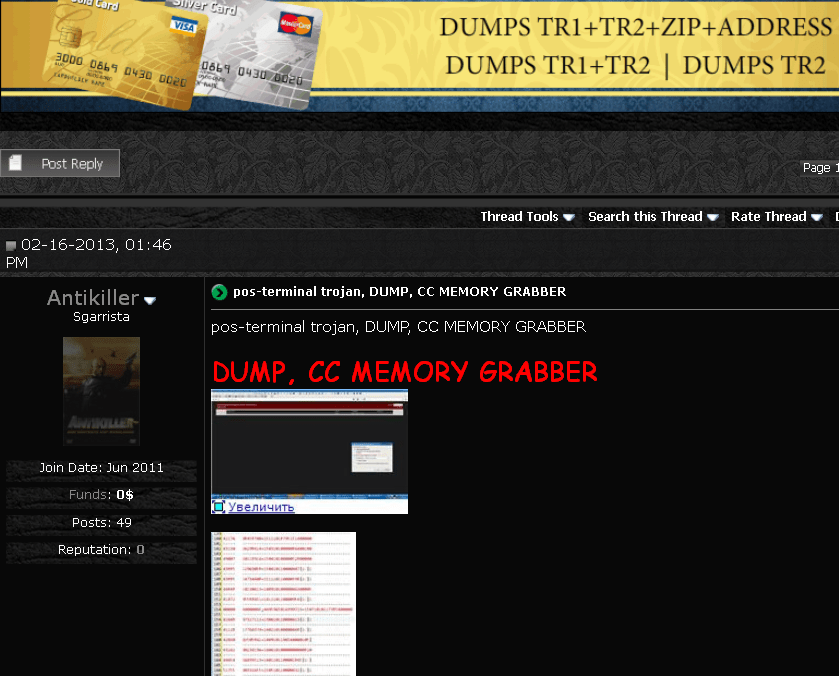
The seller of the point-of-sale “memory dump” malware allegedly used in the Target attack.
In an interview with CNBC on Jan. 12, Target CEO Gregg Steinhafel confirmed that the attackers stole card data by installing malicious software on point-of-sale (POS) devices in the checkout lines at Target stores. A report published by Reuters that same day stated that the Target breach involved memory-scraping malware.
This type of malicious software uses a technique that parses data stored briefly in the memory banks of specific POS devices; in doing so, the malware captures the data stored on the card’s magnetic stripe in the instant after it has been swiped at the terminal and is still in the system’s memory. Armed with this information, thieves can create cloned copies of the cards and use them to shop in stores for high-priced merchandise. Earlier this month, U.S. Cert issued a detailed analysis of several common memory scraping malware variants.
Target hasn’t officially released details about the POS malware involved, nor has it said exactly how the bad guys broke into their network. Since the breach, however, at least two sources with knowledge of the ongoing investigation have independently shared information about the point-of-sale malware and some of the methods allegedly used in the attack.
read the rest on his page here


